
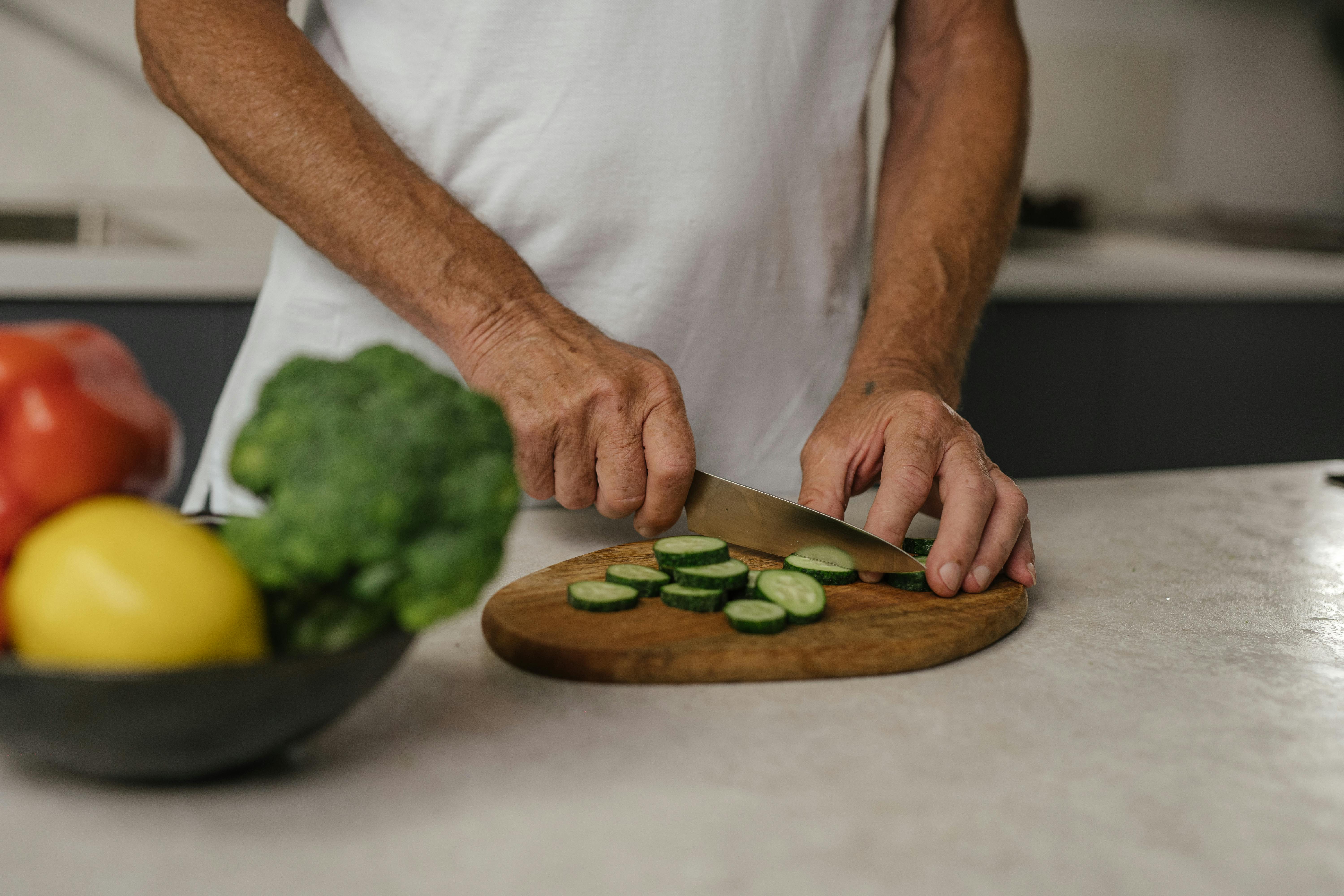
Calorie figures on packaging come from a system that assigns fixed energy values to protein, fat and carbohydrate. What a body actually extracts from a food depends on how that food was prepared.
The label system predates the question
The conversion factors behind calorie counts were established well over a century ago by burning foods and measuring heat, then adjusting for what appears in waste.
Those factors treat a gram of starch as a gram of starch, regardless of the structure it sits inside. That assumption is convenient and mostly workable.
It breaks down where the physical form of a food determines how much of it digestion can reach.
Cell walls are a physical barrier
Plant nutrients are held inside cells bounded by walls that human enzymes cannot break. Whatever stays sealed inside passes through and is fermented or excreted.
Chewing ruptures some cells; heat ruptures far more, softening the structure until the contents are exposed.
A raw whole nut and a ground, roasted nut of identical weight therefore deliver different amounts of usable energy, because the intact one keeps a share of its fat locked inside cells that never open.
The same principle applies to grains and legumes, where milling and prolonged cooking both increase the fraction of the material that digestive enzymes can actually reach.
Heat unfolds protein
Proteins in raw food are folded into compact shapes that digestive enzymes attack slowly, because the cleavage sites are buried.
Cooking denatures them, unfolding the chain and exposing those sites. Digestion then proceeds faster and more completely.
This is one reason cooking spread so early and so universally: it raised the energy return on the same quantity of food.
Starch behaves differently once cooled
Cooking starch in water swells and gelatinises it, making it highly digestible. Cooling it afterwards allows some of it to recrystallise into a form enzymes handle poorly.
That fraction is called resistant starch, and it behaves more like fibre, passing to the colon for bacterial fermentation.
Cooked and cooled potato or rice therefore differs from the same food eaten hot, though reheating partially reverses the change.
What this means for counting
Calorie labels are estimates built on averages, and their error is larger for whole plant foods than for refined products.
Refined foods have already had their structure dismantled during manufacture, so the label assumption of near-complete absorption holds well for them.
Precision in counting is therefore weakest in exactly the cases where a diet is built on whole foods, and strongest where it is built on packaged ones.
None of which makes the figures useless, since a consistent method still tracks direction over time. It makes the third decimal place a false comfort.