
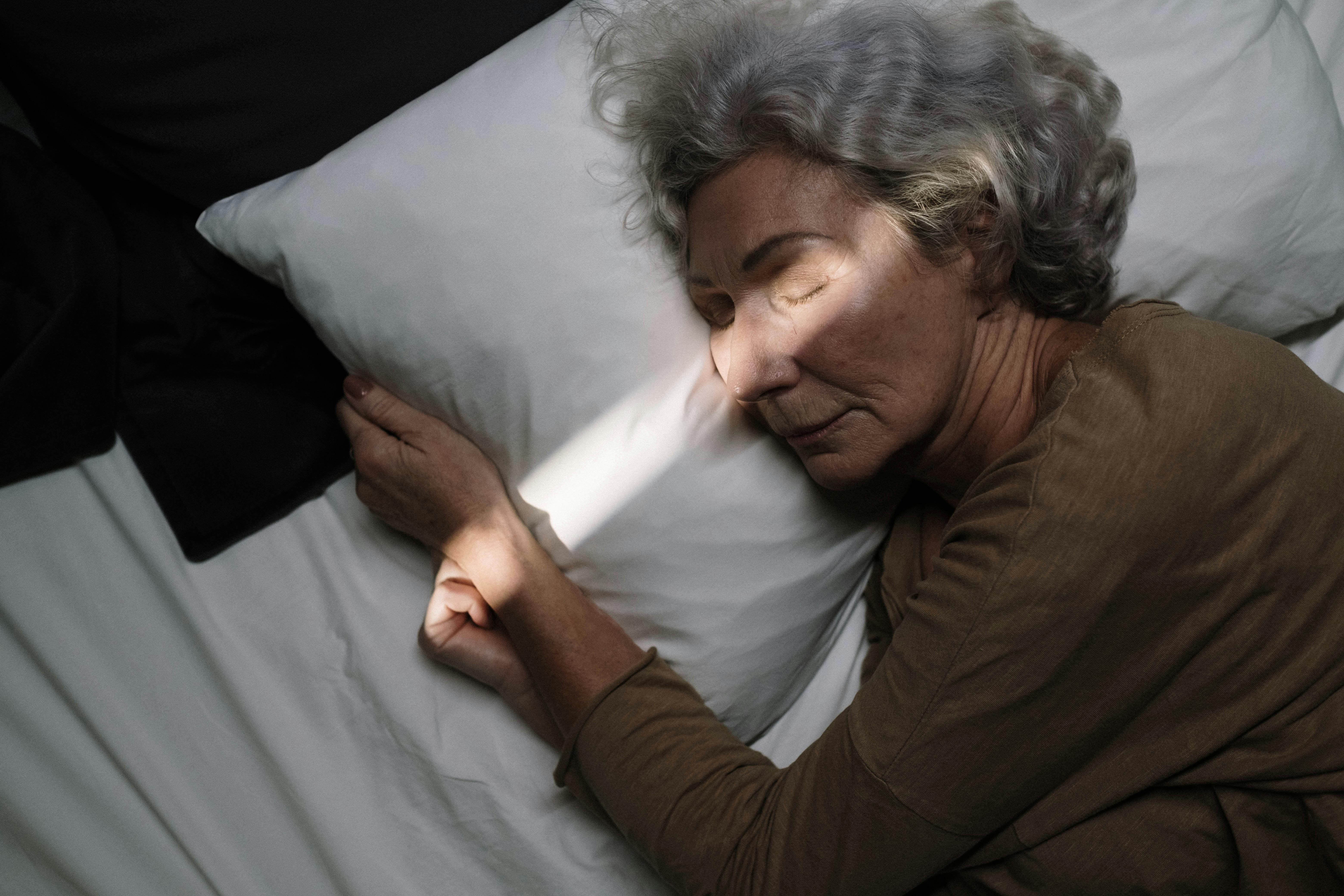
The body's daily rhythm runs slightly longer than twenty-four hours and must be reset daily. Light does that resetting, through a pathway separate from the one that produces vision.
A third class of light receptor
Alongside the rods and cones that generate images, the retina contains a small population of cells that carry their own light-sensitive pigment and respond directly to illumination.
These cells project not to the visual cortex but to the brain region that acts as the master clock, so they report ambient light level rather than contributing to what is seen.
Their pigment is most responsive to short-wavelength blue light, which is why blue light specifically features in discussions of sleep timing.
The clock resets by phase shifting
Light does not simply switch the clock on or off. It shifts the timing of the whole cycle forward or backward, and the direction depends entirely on when the light arrives.
Light in the morning advances the clock, moving sleep and waking earlier. Light in the evening delays it, pushing the whole cycle later.
Light in the middle of the biological night produces the largest shifts, which is why a bright bathroom visit at three in the morning has an effect out of proportion to its brevity.
Indoor light is dimmer than it feels
The visual system adjusts to available light and reports brightness relative to context, so a well-lit room feels comparable to an overcast day despite being far darker.
Outdoor illumination even under cloud is typically many times greater than office or domestic lighting, and the clock responds to absolute intensity rather than to perceived brightness.
This is why a day spent entirely indoors provides a weak resetting signal, leaving the rhythm free to drift later without correction.
Melatonin is the output, not the cause
The clock suppresses melatonin release during light exposure and permits it as darkness falls, so rising melatonin is a signal that biological evening has begun.
Evening light delays that release, which is the mechanism behind screen advice, though screen brightness is usually modest compared with the room lighting around it.
Melatonin marks the timing of the clock rather than driving sleep itself, which is why it functions more as a timing signal than as a sedative.
Shift work breaks the alignment
Working through the biological night means receiving light at the times that produce the largest shifts, and then attempting to sleep during hours when the clock is signalling wakefulness.
Adaptation is usually incomplete because rest days pull the rhythm back, leaving the system in permanent partial misalignment.
Managing this requires structured light exposure and scheduling that is worth setting up with occupational health support rather than improvising.